Redis array type: short story of a long development -

redis新的数据类型
github pull: github.com/redis/redis Implement the new Redis Array type (#15162)
unstable ← antirez:array
已打开 07:34AM - 04 May 26 UTC
 antirez
+22212
-34
antirez
+22212
-34
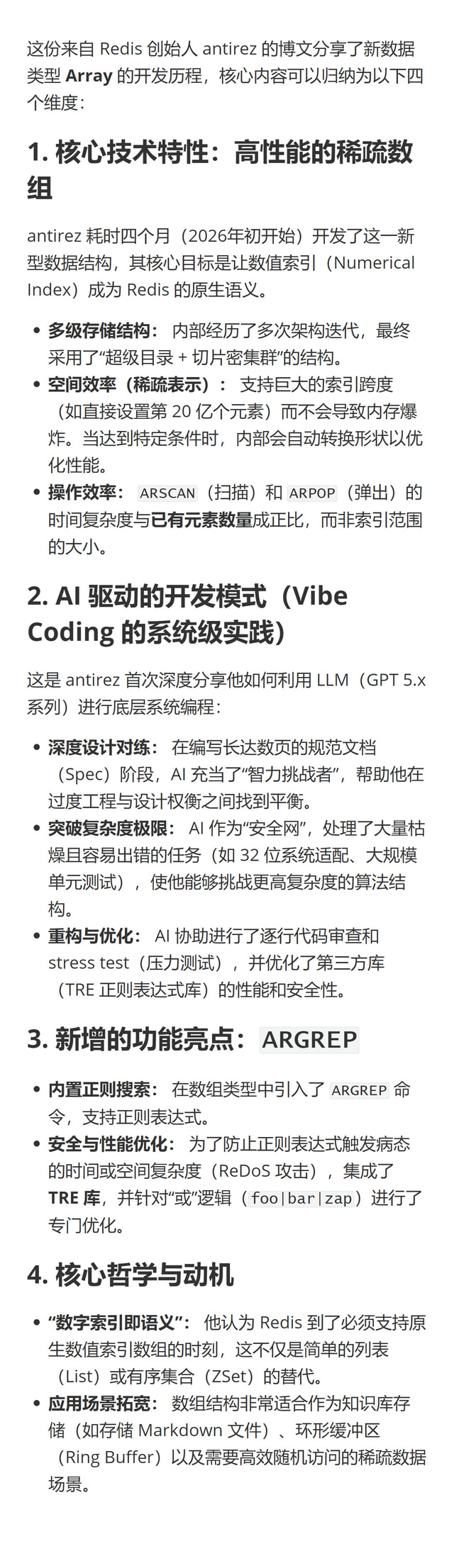
# Redis Array For years, Redis has been missing a real indexed data structure… for the use cases where the index and the spatial relationship of elements are semantic. Hashes give you random lookups, but you have to store an index as a key, and have no range visibility. Lists give you appending and trimming, but what is in the middle remains hard to access. Streams give you append-only events, which is another (useful, indeed) beast. None of these is what you want when the *position itself* has business meaning — slot 37, step 4, row 18552, day from 2934 to 2949, file line 11, 12, 15 and so forth. And, all those types, for different reasons, are all suboptimal when you want a **ring buffer** able to store the latest N observed samples of something. Up to now, users found ways (they always do \o/) using the fact that the data structures that are obvious in this universe are also extremely powerful, if well implemented. But this forces compromises. Arrays handle these index-first requirements natively, and usually with much better memory and CPU usage than the workarounds. If the use case is the right one, Arrays often provide much better space, time and usability at the same time. ## Internal encoding 1. When dense, an Array is essentially a more fancy C array. You don't pay anything for storing the index. 2. Yet, instead of going really flat, arrays are sliced into 4096-element slices, and each slice, when it contains just a few elements, uses a special sparse encoding. When a slice is empty it's just a `NULL` stored in the directory. 3. Small ints, floats, and short strings are pointer-tagged, so they cost zero additional memory beyond the pointer slot itself. 4. When very sparse, a super-directory of windowed directories is used. This allows the data type to be safe, instead of exhibiting pathological space or time behavior. This representation is only triggered when there are more than 8 million elements or very high indexes set. ## Use cases Arrays are mostly stateless if not for the fact that each array remembers the index of the latest added item, allowing `ARINSERT` and `ARRING` to work properly. Otherwise it is a set/get at this index game, with solid support for both setting / getting ranges, server-side scanning, returning only populated elements in a time which is proportional not to the range size, but to the population size. A few concrete examples, that may work as mental models for the set of problems that are similar to them (from the POV of the data modeling). **Thermometer.** A sensor reporting once per minute, with gaps: ``` ARSET temp:room12:day7 123 22.3 ARGETRANGE temp:room12:day7 600 660 # the 10:00–11:00 window, with NULLs ARSCAN temp:room12:day7 600 660 # only populated elements AROP temp:room12:day7 0 1439 MAX # peak of the day, server-side ``` Missing minutes cost little to nothing. Numeric aggregation runs inside Redis. Telemetry, IoT, meter readings, KPI rollups. **Calendar.** A clinic with 96 fifteen-minute slots per day: ``` ARSET sched:room12:day 32 booking:991 ARSCAN sched:room12:day 0 95 # only occupied slots ARGETRANGE sched:room12:day 48 63 # the afternoon full view to render ``` The slot number is the business key in this case. Room booking, parking spaces, warehouse bins, lockers, ... **Ring buffer.** ARRING replaces the classic LPUSH+LTRIM pattern. Imagine remote `dmesg`. ``` ARRING machine:123 200 "[141087.430123]: arm_cpu_init(): cpu 14 online" # Capped to 200 entries ARLASTITEMS machine:123 50 REV # 50 newest first ``` Faster than LPUSH+LTRIM, keep indexed access to past elements. Last-N alarms, recent fraud scores, access history, remote logs, device events. Ok here the use cases are mainly the ones of the old pattern: it is just a better fit and allows to access random items in the middle, aggregate server-side, and so forth. **Workflow.** Step number is the index, value is the status. Gaps are meaningful: ``` ARSET claim:99172 0 received ARSET claim:99172 3 waiting:reviewer42 ARSET claim:99172 5 approved ARGETRANGE claim:99172 0 5 # full workflow view, with NULLs for missing steps ARSCAN claim:99172 0 5 # only steps that have a state ARCOUNT claim:99172 # number of recorded steps ARLEN claim:99172 # highest reached step + 1 ``` **Skills knowledge base for agents.** Arrays are good at representing / grepping into Markdown files: ``` ARSET skill:metal_gpu 0 "...." ARSET skill:metal_gpu 1 "...." ARSET skill:metal_gpu 2 "...." ARGREP skill:metal_gpu - + RE "M3|M4" WITHVALUES ``` ARGREP has EXACT, MATCH, GLOB, RE, you can have multiple predicates, can select AND or OR behavior. **Bulk import results.** Sparse row annotations over millions of rows / CSV / ...: ``` ARSET import:job551 18552 ERR:bad_email ARSCAN import:job551 0 1000000 # Provides only rows that have something ``` ## TLDR If the position is part of the meaning, use an Array. If you want to aggregate or grep remotely, use an Array. Feedback welcome :) --- > [!NOTE] > **Medium Risk** > Adds a new vendored C regex engine (`deps/tre`) and wires it into the dependency build, which can affect build/link outputs and introduce new low-level matching code paths if adopted by the server. > > **Overview** > Introduces a new vendored dependency, **TRE POSIX regex engine**, under `deps/tre` (library sources, build scripts, and license) and adds it to the deps build/clean flow (including ignoring the produced `deps/tre/libtre.a`). > > Updates `deps/Makefile` to **propagate `SANITIZER` settings** (ASan/UBSan/TSan/MSan) into all dependency builds so sanitized Redis builds don’t link against unsanitized vendored libraries. > > <sup>Reviewed by [Cursor Bugbot](https://cursor.com/bugbot) for commit ead90ea0c48f848f8fa935d64d5e6fd4256f3659. Bugbot is set up for automated code reviews on this repo. Configure [here](https://www.cursor.com/dashboard/bugbot).</sup>
关注redis的佬可以看一下
2 个帖子 - 2 位参与者